Exothermic Welding MOLDS
- Home
/ Products

Exothermic Welding MOLDS
Exothermic Welding Process, Also Known as Thermite Welding -THERMOWELD Supplier in Saudi Arab
THERMOWELD® GROUNDING | LIGHTNING PROTECTION | CATHODIC PROTECTION | ENERGY an exothermic welding mould is manufactured from high-quality graphite, accurate production and expert engineering
Exothermic welding is a process that bonds conductors to conductor, or conductors to steel surface together, by molecular bonding with no porosity inside weld joint. This results in excellent electrical conductivity, and superior mechanical strength in every environmental condition. The welded joint can be buried directly in soil or concrete, making it ideal for underground Electrical systems in substations and power plants, Cathodic protection for pipelines, Railway systems, Lightning protection systems, Telecommunication networks, and any installation requiring long-term reliability. Unlike mechanical connections, exothermic welds do not loosen over time and provide a service in life itself.
| “Exothermic” is a chemical term used to describe a reaction that produces heat. INTRODUCTION Exothermic welding, also known as “thermit welding” or “aluminothermic welding” is a welding process for permanently joining materials (usually copper conductors) that employs an exothermic reaction. The exothermic reaction requires no external heat or a power source. All that is required is a spark to initiate the reaction" |
 |
| The Exothermic reaction occurs between copper oxide and aluminium powder (contained within the weld metal) creating molten super-heated copper and an aluminium oxide slag. When an ignition spark comes into contact with the weld metal, it causes an exothermic reaction within the weld metal, melting and separating the metals. The aluminium rises to the top of the connection creating a slag leaving the molten copper to flow around the joint, creating the weld. The KingsWeld exothermic connection is a permanent, maintenance-free weld that will not loosen overtime or deteriorate with age. The connections’ current carrying capability is equal to or greater than that of the conductors being joined. In other words, there is no increase in resistance in an exothermically welded connection, unlike in most pressure type (bolt/crimp) connections. |
 |
| Introduction to exothermic welding Throughout the world, exothermic welding has been shown to be the best choice where safety, reliability, current carrying capacity and longevity are critical. The advantages of exothermic welding 1 The current carrying capacity of the connection is greater than or equal to that of the conductor 2 Has a lower electrical resistance than a mechanical connection 3 Does not deteriorate with age 4 Does not loosen over time 5 Can withstand repeated high current surges without deterioration 6 Does not require an external power source 7 Used to weld copper, copper alloys, copper bonded steel, various steel alloys, including stainless steel 8 Quick and easy to install 9 Exceptional corrosion resistance due a very high copper content (97%+) 10 Fusion temperature is in excess of 2000°C forming a molecular bond This adds up to a superior connection when compared to mechanical or pressure type (crimp) connectors. The KingsWeld exothermic connection is the best choice, especially in safety critical environments where reliability, longevity and current carrying capacity are paramount |
 |
| Introduction to exothermic welding. Throughout the world, exothermic welding has been shown to be the best choice where safety, reliability, current carrying capacity and longevity are critical. The advantages of exothermic welding 1 The current carrying capacity of the connection is greater than or equal to that of the conductor 2 Has a lower electrical resistance than a mechanical connection 3 Does not deteriorate with age 4 Does not loosen over time 5 Can withstand repeated high current surges without deterioration 6 Does not require an external power source 7 Used to weld copper, copper alloys, copper bonded steel, various steel alloys, including stainless steel 8 Quick and easy to install 9 Exceptional corrosion resistance due a very high copper content (97%+) 10 Fusion temperature is in excess of 2000°C forming a molecular bond This adds up to a superior connection when compared to mechanical or pressure type (crimp) connectors. The KingsWeld exothermic connection is the best choice, especially in safety critical environments where reliability, longevity and current carrying capacity are paramount |
 |
 |
 |
 |
 |
 |
 |
 |
| Exhothermic Mold | Exhothermic Powder | Flint Gun | Card Cloth Brush | Handle clamp for mold | Mold Scraper | Fine Cleaning Brush |
|
|||||||||||||||||||||||||||||
|
The Exothermic Process has been used to weld materials other than copper for electrical purpose. Materials welded include :
When welding to galvanized steel it is recommended to resurface exposed bare steel. The Exothermic Welded Connection is a molecular weld. The weld has the same melting point as copper. This factor among with the increased cross sectional area of the connection and the following insure :
|
|||||||||||||||||||||||||||||
Thermoweld Weld Mold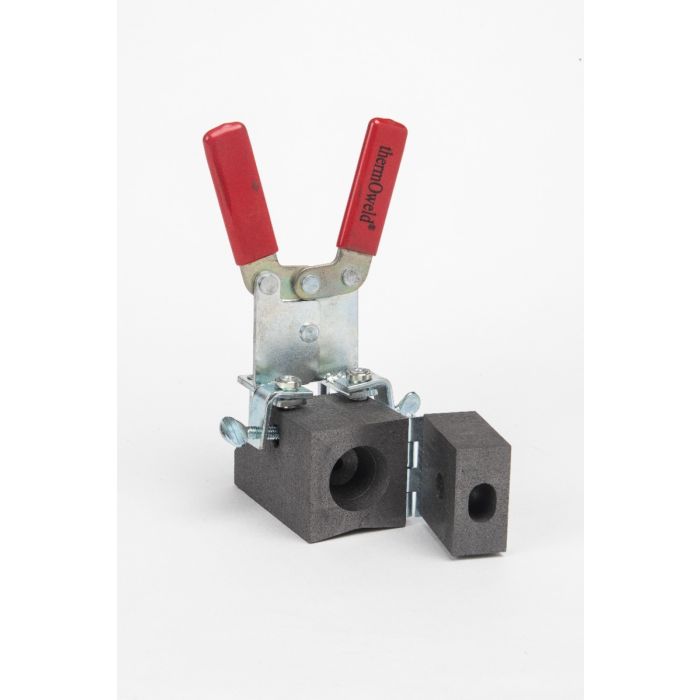 |
Thermoweld Weld Molds are precision-engineered molds designed for use in exothermic welding to ensure strong, efficient, and lasting connections in grounding and bonding systems. These molds accommodate a wide range of conductor sizes and installation requirements, with options suitable for steel, pipe, and flat surfaces in vertical orientations.Representative Models:
|
Thermoweld molds are available in various configurations, including specific compatibility with large pipe sizes (10" and up), vertical steel applications, and equivalents to ERICO and CADWELD mold types for seamless integration with existing systems.
Key Features:
- Durable graphite molds for consistent, repeatable welds
- Supports a wide range of conductor sizes and geometries
- Specialized molds for vertical pipe welds and flat surfaces
- ERICO and CADWELD compatible models available
Designed for reliability in the most demanding environments, Thermoweld Weld Molds are a trusted solution for permanent grounding and bonding connections across utility, industrial, and telecommunications projects.
Thermoweld Weld Molds are precision-engineered molds designed for use in exothermic welding to ensure strong, efficient, and lasting connections in grounding and bonding systems. These molds accommodate a wide range of conductor sizes and installation requirements, with options suitable for steel, pipe, and flat surfaces in vertical orientations.
Exothermic welding is a highly effective welding process that uses a chemical reaction to produce molten metal, creating strong and durable bonds between conductors without the need for external heat sources.
What is Exothermic Welding?
Exothermic welding, also known as exothermic bonding, thermite welding (TW), and thermite welding, is a welding process that employs molten metal to permanently join the conductors. The process employs an exothermic reaction of a thermite composition to heat the metal, and requires no external source of heat or current. The chemical reaction that produces the heat is an aluminothermic reaction between aluminum powder and a metal oxide.